 HRTD Medical Institute HRTD Medical Institute

Location of DMA Course 1 Year
Location of Diploma In Medical Assistant (DMA) course 1 Year Training Institute. Mobile Number.01987073965. 01941123488, 01797522136. HRTD Medical Institute , Abdul Ali Madbor Mention, Section-6, Block-Kha, Road-1, Plot-11, Mirpur-10 (Gol-Chattar) Metro Rail Pilar NO-249, Dhaka-1216. It is situated by the West Side of Agrani Bank, the South Side of Fire Service, Islami Bank, Janata Bank, Social Islami Bank, Medinova, Ibrahim Diabetic Hospital, the North Side of Baitul Mamur Jame Mosjid, Grave of Baitul Mamur Jame Mosjid, and East Side of Maliha Apartment.
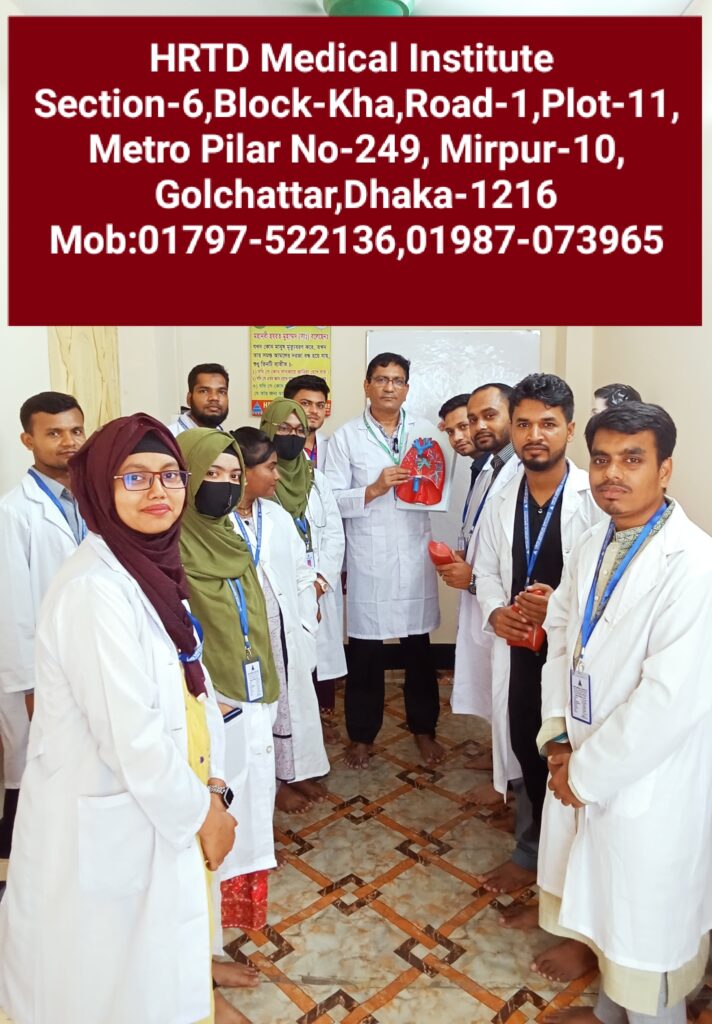
DMA Course 1 Year Details:
DMA Course 1 Years : Mobile Number. 01987073965. 01941123488, 01797522136. The full Meaning of DMA is (Diploma In Medical Assistant). A DMA course of 1 Year 1 duration is a Short Type of DMA Course in Bangladesh This Course contains 10 subject in 2 semesters. The 1st Semester contains 5 subject and 2nd semester contains 5 subjects.
Course Fee for DMA Course 1Year in Dhaka, Bangladesh
Course Fee for DMA Course 1 Year. Mobile Number. 01987073965. 01941123488, 01797522136. DMA Course Fee for 1 Year TK 52,500/- Including Admission Fee, Monthly Fee & Exam Fee.
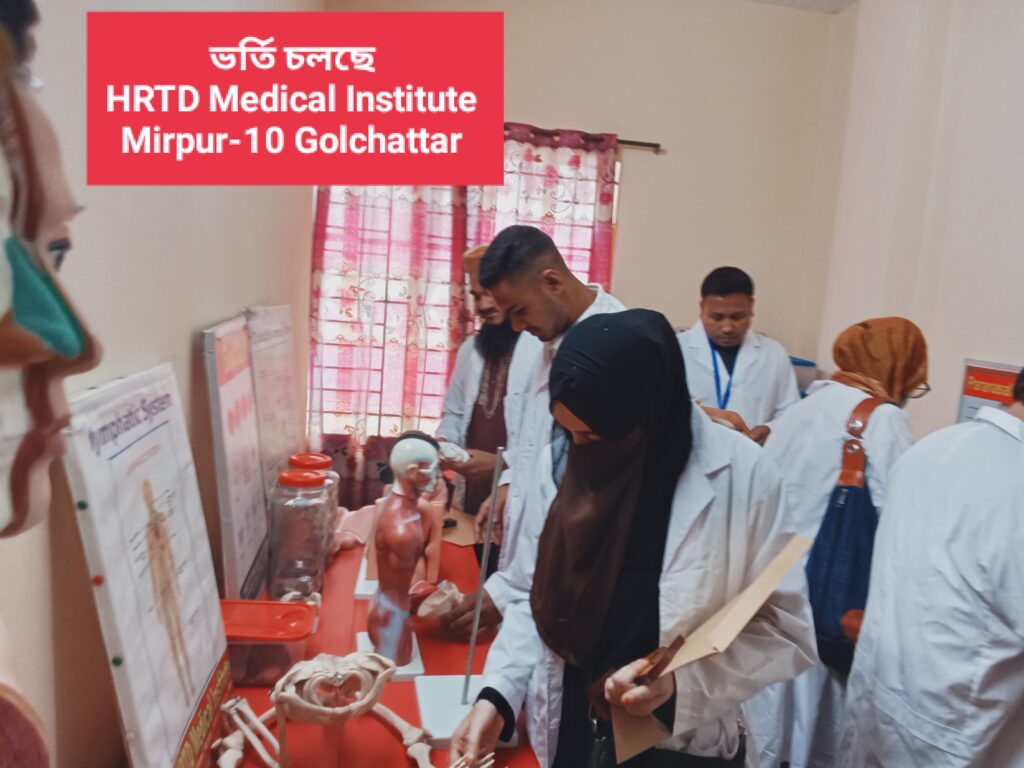
DMA Course 1 Year Admission Eligibility in Dhaka, Bangladesh
DMA Course 1 Year Admission Eligibility. Mobile Number. 01987073965. 01941123488, 01797522136. SSC or Equivalent/HSC/ Degree/ Masters from any Background (Science/ Arts/ Commerce/ Technical).
Document for admission in DMA Course 1 Year
DMA Course in Dhaka. Mobile No: 01987-073965, 01797-522136. HRTD Medical Institute.
Photocopy of Certificate, Photocopy of NID, Passport Size Photo 4 Pcs. Without NID, a Birth Certificate is allowed for an emergency case.
Subjects Details For DMA Course 1 Year
DMA Course 1 Year Contains 10 Subject. Human Anatomy & Physiology,Pharmacology-1,Study of OTC, First Aid, Practice of Medicine,Hematology-1,Pathology for Medical Practice, Cardiovascular Anatomy, Orthopedic Anatomy,Surgery-1,Antimicrobial Drug, Medical Diagnosis,

Teachers For DMA Course 1 Year
- Dr. Md. Sakulur Rahman, MBBS, CCD (BIRDEM), Course Director
- Dr. Sanjana Binte Ahmed, BDS, MPH, Assistant Course Director
- Dr. Tisha, MBBS, PGT Gyne, Assistant Course Director
- Dr. Suhana, MBBS, PGT Medicine
- Dr. Danial Hoque, MBBS, C-Card
- Dr. Tisha, MBBS
- Dr. Afrin Jahan, MBBS, PGT Medicine
- Dr. Ananna, MBBS
- Dr. Lamia Afroze, MBBS
- Dr. Amena Afroze Anu, MBBS, PGT Gyne, Assistant Course Director
- Dr. Farhana Antara, MBBS,
- Dr. Nazmun Nahar Juthi, BDS, PGT
- Dr. Farhana Sharna, MBBS
- Dr. Bushra, MBBS
- Dr. Turzo, MBBS
- Dr. Kamrunnahar Keya, BDS, PGT (Dhaka Dental College)
- Dr. Shamima, MBBS, PGT Gyne
- Dr. Alamin, MBBS
- Dr. Benzir Belal, MBBS
- Dr. Disha, MBBS
- Dr. Mahinul Islam, MBBS
- Dr. Tisha, MBBS, PGT Medicine
- Dr. Anika, MBBS, PGT
- Dr. Jannatul Ferdous, MBBS, PGT Gyne
- Dr. Jannatul Aman, MBBS, PGT
- Dr. Rayhan, BPT
- Dr. Abu Hurayra, BPT
- Dr. Sharmin Ankhi, MBBS, PGT Medicine
- Md. Monir Hossain, B Pharm, M Pharm
- Md. Monirul Islam, B Pharm, M Pharm
- Md. Feroj Ahmed, BSc Pathology, PDT Medicine
Practical Classes For DMA Course 1 Year
- Heart Beat, Heart Rate
- Heart Sound,Pulse
- Blood Pressure, Hypertension, Hypotension
- First Aid Box
- Auscultation
- Inhaler, Rotahaler
- Nebulizer
- Glucometer Blood Glucose
- Injection I/V
- Injection I/M
- Cleaning,Dressing,Bandaging
- Saline
- CPR
- Stitch
- Body Temperature
- Nasal Tube Gel ,Hand Wash
- Blood Grouping
- Cyanosis, Dehydration Test, Edema Test
Subjects for DMA Course 1 Year
DMA Course 1 Year Contains 10 Subject In 2 Semester. Mobile Number: 01987-073965,01797-522136
1st Semester Subjects:
- Human Anatomy & Physiology-1
- Pharmacology-1
- Study of OTC Drugs
- First Aid-1 & 2 & Practice of Medicine
- Hematology & Pathology for Medical Practice
2nd Semester Subjects:
- Cardiovascular Anatomy
- Orthopedic Anatomy
- Surgery-1 & Antimicrobial Drugs
- Medical Diagnosis-1 & 2
- Chemistry & Medical Biochemistry
Some Practical class Details Given Below For DMA Course 1 Year
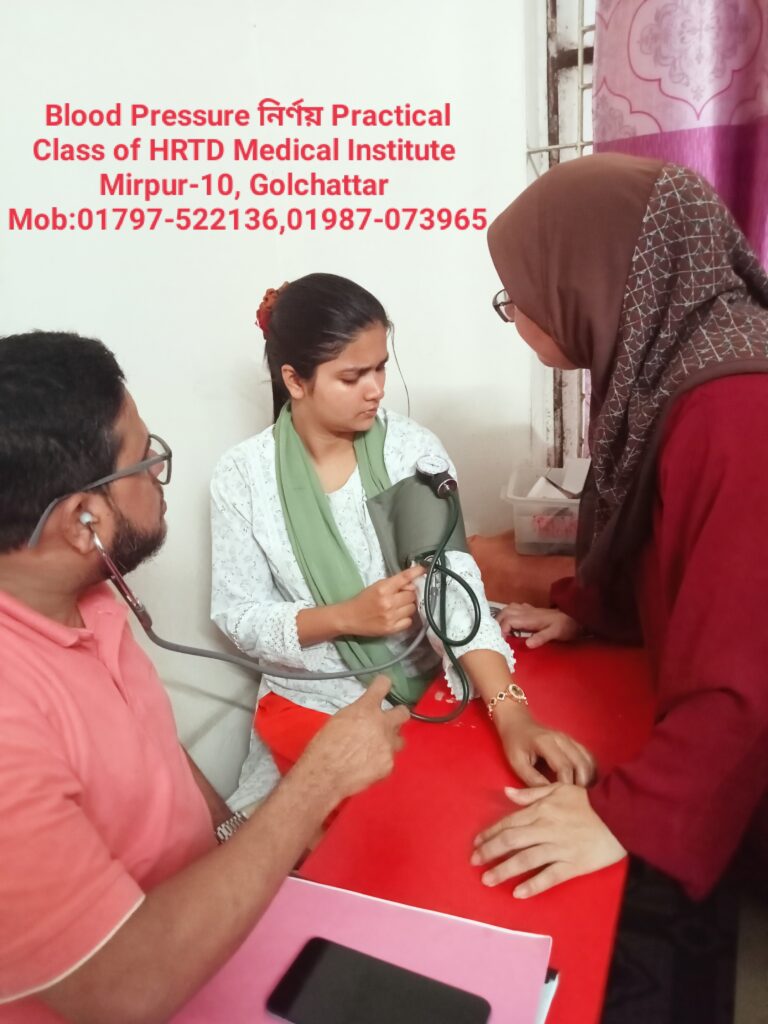
Blood pressure (BP) Practical For DMA Course 1 Year
Blood pressure (BP) measures the force of blood against artery walls, recorded as two numbers: Systolic (top, heart beats) over Diastolic (bottom, heart rests), in mmHg (e.g., 120/80). Normal is below 120/80 mmHg, while readings consistently over 130/80 mmHg or 140/90 mmHg (depending on location) indicate high BP (Hypertension). High BP increases risks for heart attack, stroke, and kidney disease, often linked to diet, exercise, stress, and genetics, but can be managed with lifestyle changes or medication.
Blood Pressure Categories (Mayo Clinic)
- Normal: Below 120/80 mmHg.
- Elevated: Systolic (top number) 120-129 AND diastolic (bottom) less than 80.
- Stage 1 Hypertension: Systolic 130-139 OR diastolic 80-89.
- Stage 2 Hypertension: Systolic 140 or higher OR diastolic 90 or higher.
Key Details
- Systolic (Top Number): Pressure when the heart pumps blood out.
- Diastolic (Bottom Number): Pressure when the heart rests between beats.
- Factors Affecting BP: Activity, body position, emotions, sleep, diet, smoking, alcohol.
- Hypertension (High BP): Often called the “silent killer” as it may have no symptoms but significantly raises risk for serious conditions.
- Hypotension (Low BP): Can also cause issues if too low.
Management & Importance
Regular checks are crucial, as consistent high readings signal hypertension, requiring medical guidance for lifestyle changes (diet, exercise, less salt/alcohol, weight management) or medication to prevent severe complications like heart attack, stroke, or kidney failure
Hypertension, or high blood pressure, is when blood forcefully pushes against artery walls, often without symptoms, but significantly raising risks for heart attack, stroke, and kidney disease. Diagnosed at or above 130/80 mmHg, it’s managed through lifestyle changes (diet, exercise, less salt/alcohol) and medications, though dangerously high readings (over 180/120 mmHg) need emergency care, as it’s often called the “silent killer” because it goes unnoticed until severe complications arise.
Glucometer Blood Glucose Practical For DMA Course 1 Year
A glucometer (blood sugar meter) is a portable medical device that measures the amount of sugar (glucose) in a drop of blood, essential for managing diabetes by helping you see how food, exercise, and medicine affect your levels, typically using a finger prick and a test strip to get a reading in mg/dL or mmol/L within seconds. To use, you prick your finger (after washing hands), touch the blood to a test strip, and the meter displays your blood sugar level, guiding treatment and preventing complications.
How it Works
- Prepare: Wash hands, insert a test strip into the meter (this turns it on).
- Lancet: Prepare a lancet device, setting the depth and loading it.
- Prick: Firmly press the lancet on the side of your fingertip and squeeze a small blood drop.
- Apply Blood: Touch the drop to the edge of the test strip.
- Read: The meter counts down and displays the glucose level (e.g., 80-130 mg/dL is a common target before meals).
Key Things to Know
- Purpose: To manage diabetes by tracking glucose levels, preventing highs (hyperglycemia) and lows (hypoglycemia).
- Components: A handheld meter, disposable test strips, and lancets.
- Accuracy: Store strips properly (sealed, room temp) and check expiration dates; a small drop of blood is needed.
- When to Use: People with diabetes use them multiple times daily to guide treatment.
Target Ranges (General Guidelines)
- Before Meals (Preprandial): 80-130 mg/dL.
- After Meals (Postprandial): Less than 180 mg/dL (2 hours after starting to eat).
By monitoring these numbers, you and your healthcare provider can adjust diet, exercise, and medication to keep your blood sugar in a healthy range.
Nebulizer Practical For DMA Course 1 Year
A nebulizer is a medical device that converts liquid medication into a fine mist, which is then easily inhaled into the lungs through a mouthpiece or a mask. They are commonly used to treat respiratory conditions like asthma, COPD, and cystic fibrosis, particularly in patients who struggle with traditional inhalers, such as young children or those with severe lung disease.
Types of Nebulizers
Nebulizers are categorized by their mechanism of action and portability.
- Jet Nebulizers: These use a compressed gas (like air) to create the mist.
- Pros: They are generally the most affordable and can deliver a wide range of medications, including suspensions.
- Cons: They are often larger, bulkier, and tend to be noisy (around 60 dB).
- Ultrasonic Nebulizers: These use high-frequency sound waves (vibrations) to produce an aerosol mist.
- Pros: They are quieter and faster than jet nebulizers.
- Cons: They are typically more expensive and the heat generated may not be suitable for all medications, such as heat-sensitive proteins.
- Mesh Nebulizers: This is the newest technology, using a fine mesh or aperture plate with tiny holes that vibrate to push the liquid medication through and create a fine mist.
- Pros: They are highly efficient, portable, very quiet, and battery-operated options are available, making them suitable for travel.
- Cons: They are the most expensive type and require meticulous cleaning to prevent the mesh from clogging, especially with thicker medications or suspensions.
Usage and Maintenance
Using a nebulizer correctly is crucial for effective treatment.
How to Use a Nebulizer
- Wash your hands thoroughly.
- Connect the hose to the air compressor unit.
- Fill the medicine cup with the prescribed liquid medication. Be careful not to spill.
- Attach the mouthpiece or mask to the medicine cup.
- Turn on the machine and place the mouthpiece in your mouth (lips sealed around it) or fit the mask snugly over your nose and mouth.
- Breathe slowly and deeply through your mouth until all the medicine is gone (usually 5 to 20 minutes).
- Turn off the machine when done.
Care and Cleaning
- After each use: Wash the medicine cup and mouthpiece/mask with warm running water and allow them to air dry on a clean paper towel.
- Regularly: Disinfect the parts as per the manufacturer’s instructions.
- Never wash the tubing/hose.
- Change the filter when it becomes dirty, as specified in the instructions
Human Anatomy & Physiology for DMA Course 1 Year
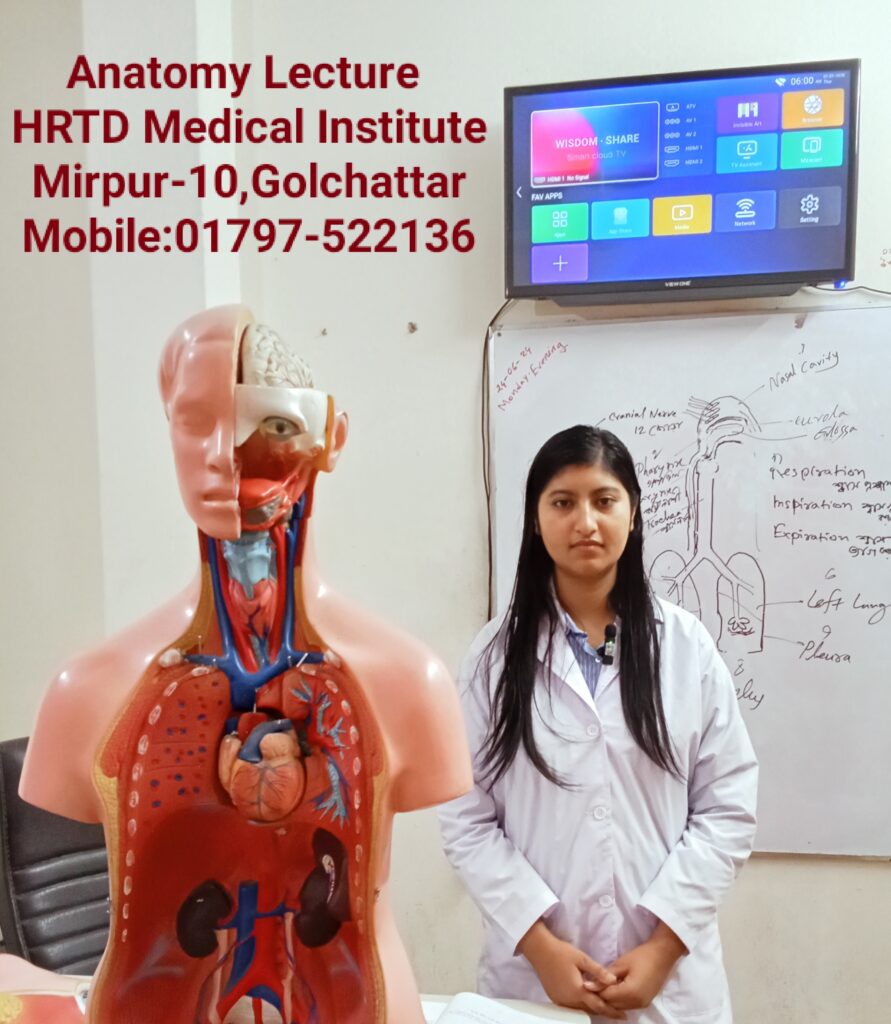
The Study of the body Structure and its function is Anatomy & Physiology. Here we discuss the systems of the human body and its organ, Tissues, and cells. The systems of the human body are the digestive system, Respiratory system, Cardiovascular system, Skeletal system, Muscular system, nervous system, Endocrine system, Immune System, Integumentary System and Urinary System.
Definition
Anatomy (English):
Anatomy is the study of the structure of the human body and the relationship between body parts.
অ্যানাটমি (বাংলা):
অ্যানাটমি হলো মানবদেহের গঠন, অঙ্গ-প্রত্যঙ্গ এবং তাদের পারস্পরিক সম্পর্কের অধ্যয়ন।
Physiology (English):
Physiology is the study of the functions of the human body and how body parts work.
ফিজিওলজি (বাংলা):
ফিজিওলজি হলো মানবদেহের বিভিন্ন অঙ্গ কীভাবে কাজ করে তার অধ্যয়ন।
Levels of Organization (শরীরের গঠনের স্তর)
- Cell (কোষ) – দেহের সবচেয়ে ছোট জীবিত একক
- Tissue (টিস্যু) – একই ধরনের কোষের সমষ্টি
- Organ (অঙ্গ) – বিভিন্ন টিস্যু দিয়ে গঠিত (যেমন: হৃদপিণ্ড)
- System (সিস্টেম) – একাধিক অঙ্গের সমন্বয়
- Organism (সম্পূর্ণ মানবদেহ)
Major Systems of Human Body
| System | Main Function |
|---|---|
| Skeletal System | দেহকে আকৃতি ও সাপোর্ট দেয় |
| Muscular System | চলাচল ও শক্তি উৎপাদন |
| Nervous System | দেহের নিয়ন্ত্রণ ও সমন্বয় |
| Cardiovascular System | রক্ত পরিবহন |
| Respiratory System | শ্বাস-প্রশ্বাস |
| Digestive System | খাদ্য হজম |
| Urinary System | বর্জ্য নির্গমন |
| Endocrine System | হরমোন নিঃসরণ |
| Reproductive System | প্রজনন |
| Integumentary System | ত্বক ও সুরক্ষা |
কয়েকটি সিস্টেম সম্পর্কে আলোচনা করা হলো:
1. Skeletal System
Function:
- Gives shape and support to the body
- Protects vital organs (brain, heart, lungs)
- Helps in body movement
- Produces blood cells in bone marrow
Main Parts:
- Bones (206 bones)
- Joints
- Cartilage
2. Muscular System
Function:
- Enables movement of the body
- Maintains posture
- Produces heat
Types of Muscles:
- Skeletal muscle – voluntary
- Smooth muscle – involuntary
- Cardiac muscle – found in the heart
3. Nervous System
Function:
- Controls and coordinates body activities
- Receives and responds to stimuli
- Responsible for thinking, memory, and emotions
Main Parts:
- Brain
- Spinal cord
- Nerves
4. Cardiovascular System
Function:
- Circulates blood throughout the body
- Transports oxygen, nutrients, and hormones
- Removes waste products
Main Parts:
- Heart
- Blood
- Blood vessels (arteries, veins, capillaries)
5. Respiratory System
Function:
- Helps in breathing
- Supplies oxygen to the blood
- Removes carbon dioxide from the body
Main Parts:
- Nose
- Trachea
- Lungs
- Alveoli
6. Digestive System
Function:
- Digestion of food
- Absorption of nutrients
- Elimination of waste
Main Parts:
- Mouth
- Esophagus
- Stomach
- Intestines
- Liver and pancreas
Pharmacology-1 for DMA Course 1 Year
1. Definition of Pharmacology
Pharmacology is the branch of medical science that deals with drugs, their sources, actions, uses, side effects, and mechanisms in the human body.
2. Drug – Definition
A drug is a chemical substance that is used to diagnose, prevent, treat, or cure disease.
3. Branches of Pharmacology
- Pharmacokinetics – What the body does to the drug
- Pharmacodynamics – What the drug does to the body
- Pharmacotherapeutics – Use of drugs in treatment
- Toxicology – Study of harmful effects of drugs
- Chemotherapy – Drugs used to treat infections and cancer
4. Pharmacokinetics (ADME)
A – Absorption:
How a drug enters the bloodstream
D – Distribution:
How the drug spreads in the body
M – Metabolism:
Breakdown of drugs mainly in the liver
E – Excretion:
Removal of drugs mainly through kidneys (urine)
5. Pharmacodynamics
- Drug action and effect
- Receptor interaction
- Dose–response relationship
Example:
Paracetamol reduces pain and fever.
6. Routes of Drug Administration
- Oral (by mouth)
- Sublingual
- Intravenous (IV)
- Intramuscular (IM)
- Subcutaneous (SC)
- Topical
- Inhalation
7. Types of Drugs
- Analgesics (pain killers)
- Antibiotics
- Antipyretics (reduce fever)
- Antiseptics
- Sedatives
8. Adverse Drug Reactions (ADR)
- Nausea
- Vomiting
- Allergy
- Drowsiness
9. Importance of Pharmacology for Nurses / Physiotherapists
- Safe drug administration
- Understanding drug effects
- Prevention of medication errors
- Patient education
10. Common Terms
- Dose: Amount of drug given
- Therapeutic effect: Desired effect
- Side effect: Unwanted effect
- Overdose: Excess amount of drug

